Ferrari: The Business That Grows by Selling Less Than It Could
Ferrari is not your typycal car manufacturer.

We’ve all seen those red cars racing in Formula 1.
You instantly recognize them. Not just because of the color, but because of that iconic emblem known as the Cavallino Rampante (Prancing Horse).
Yes, I’m talking about Ferrari.
“Oh, a luxury car company,” you might say.
But not exactly.
At its core, Ferrari is a company that manages one of the most desirable brands in the world. It’s not just another automaker.
Yes, the cars are the product.
But the business is something else entirely.
Ferrari is a luxury house, more comparable to LVMH than to a traditional car manufacturer.
What Ferrari Really Does
Ferrari designs, manufactures, and sells high-performance sports cars.
But unlike most automakers, it does not compete on volume, price, or market share.
It competes on something far scarcer: desirability.
And that changes everything.
The Business Model
To survive in a highly competitive industry, most car manufacturers try to produce and sell more vehicles every year.
Ferrari is different.
It operates under a simple idea:
Always produce one fewer car than the market demands.
That decision has several consequences:
Demand remains higher than supply
Ferrari doesn’t need discounts to sell cars
It can raise prices without hurting demand
“Hold your horses, Ezra… are you telling me Ferrari competes by making fewer cars?”
Yes.
Because scarcity is not a limitation of the business.
It is the product.
Ferrari doesn’t look for customers.
It builds collectors.
Its business model doesn’t end when the car is sold.
That’s where it begins.
In 2025, 84% of Ferrari’s new cars were purchased by existing Ferrari owners. And more than half of those were sold to people who already owned multiple Ferraris.
Over time, the customer stops buying a car.
They begin building a collection.
They become part of a community.
Ferrari creates a long-term relationship through:
Extreme personalization
Access to limited models
Preferential treatment
A closed community
The Invisible Asset: Resale Value
Beyond the community, one of the most important parts of Ferrari’s model is how aggressively it protects resale value.
That completely changes the buying decision.
If a customer believes their Ferrari will hold — or even increase — its value over time, the real cost of ownership becomes much lower.
In some cases, even negative.
Why does that matter?
Because it makes buying the next Ferrari much easier.
The secondary market is not a side effect of the business.
It is part of the business.
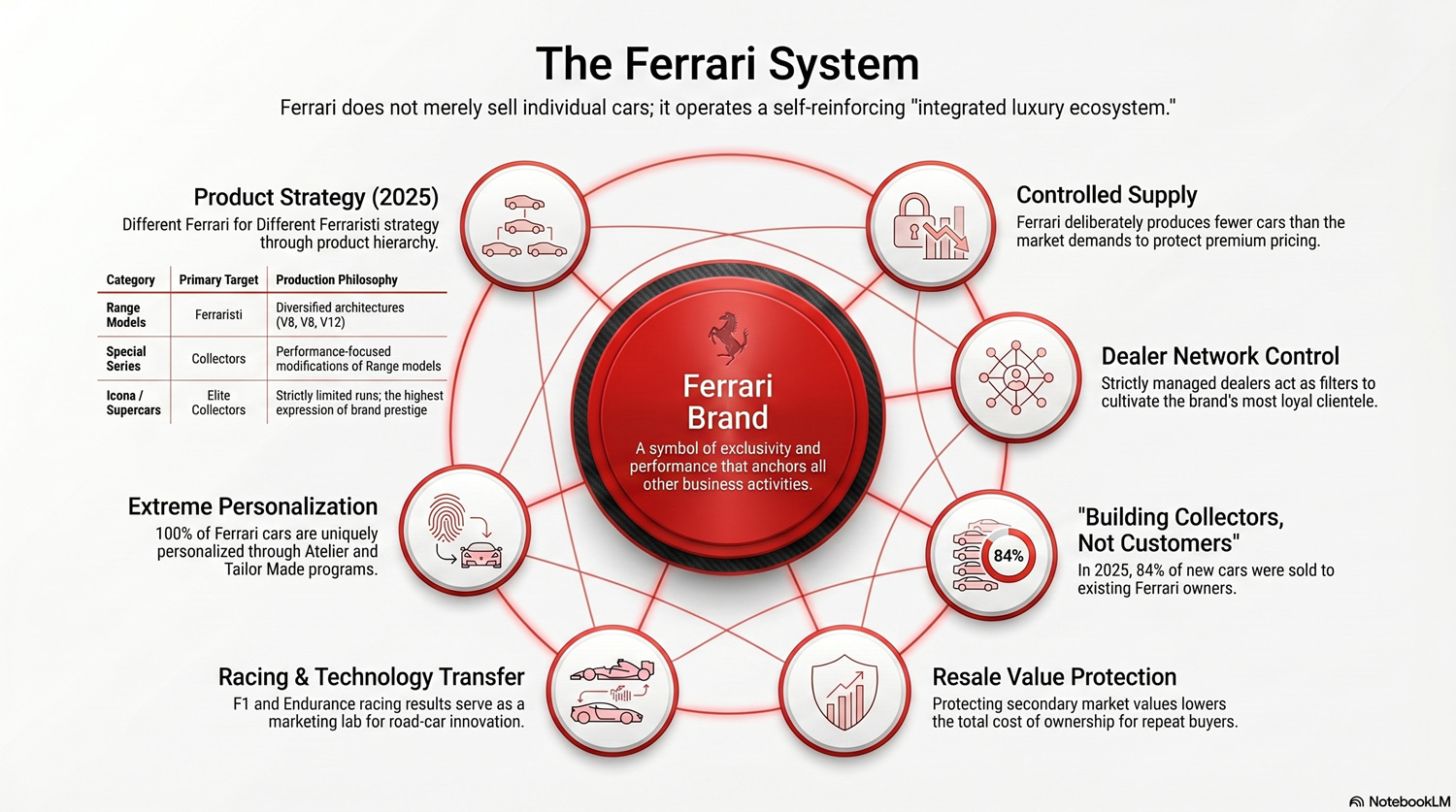
Limited production, personalization, community, and resale value are not independent decisions.
They are designed to reinforce one another.
Ferrari does not sell individual cars.
It builds a system that compounds value over time.
The Role of Dealerships
Ferrari does not own its dealerships.
But it controls them rigorously.
They are not treated as simple distributors, but as extensions of the brand itself.
Ferrari uses dealerships to:
Control the customer experience
Manage vehicle allocation
Maintain exclusivity
Protect resale value
Serve as community touchpoints
The dealership does not simply sell cars.
It filters, nurtures, and cultivates the customer.
A Self-Reinforcing System
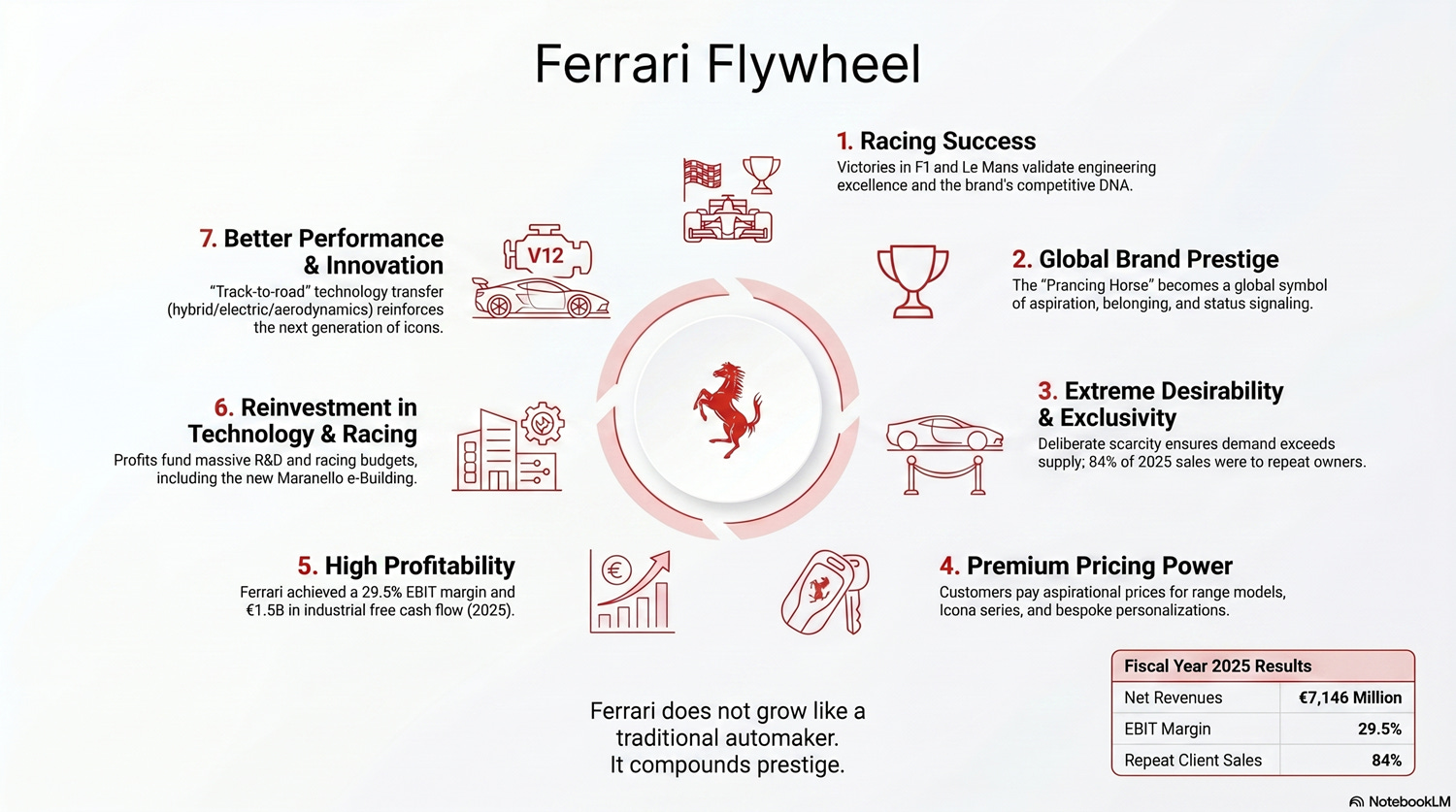
Ferrari’s business is not linear.
It is a system.
Racing creates visibility.
Visibility creates desirability.
Desirability enables premium pricing.
Premium pricing generates profits.
Profits are reinvested into technology and racing.
And the cycle repeats itself.
Competitive Advantage
At first glance, Ferrari’s model may appear replicable.
It isn’t.
The company is protected by several powerful shields:
More than 75 years of history
Continuous presence in Formula 1
An extremely loyal customer base
Tight control over distribution
None of this is built quickly.
And none of it can simply be bought.
Final Thoughts
To close this profile, I’ll leave you with a comment from Guy Spier, CEO of Aquamarine Capital, during an interview with MOI Global:
Ferrari is not an automobile company. Ferrari is a luxury goods company. Ferrari doesn’t need to be at the forefront of technology, even if they say they are.
There will always be demand and desire — especially among men, more than women — to own a vehicle that makes them feel special.
They are in the business of providing experiences for people who want to feel special.
If you’d like to keep reading pieces like this one, I’d be glad to have you as a subscriber.
Ezra’s Notes is free, and it helps me write more essays worth your time.